
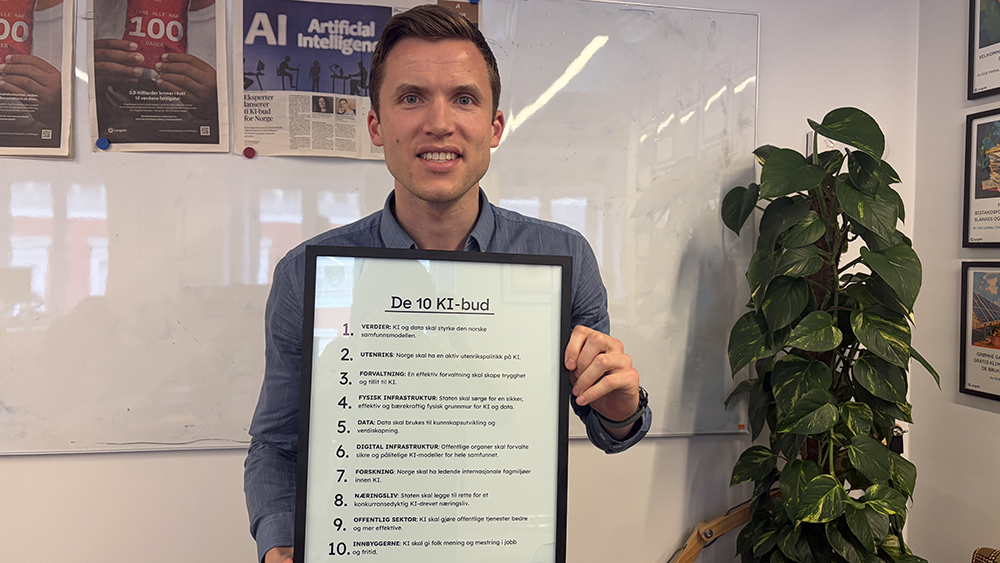
Langsikt is an independent Norwegian think tank focused on long-term policy challenges. Drawing inspiration from Norway’s Ten Oil Commandments from 1971, Langsikt has developed Ten AI Commandments to guide how data and artificial intelligence should be governed in the years ahead.
Data and AI are a new kind of resource. Like oil once was, they have the potential to create enormous value, but also to reshape power, labour markets and society in ways that are hard to reverse.
ANE’s Tove Keldsen sat down with Eirik Mofoss, Managing Director of Langsikt and himself an engineer, to talk about the Ten AI Commandments, why they were created, how they are meant to be used, and whether small, open economies like the Nordic countries still have real influence in a world dominated by global tech giants.
Why ten commandments and why now?

The Ten AI Commandments, written by an expert group of 15 people commissioned by Langsikt, are deliberately not a technical checklist or a short‑term AI strategy. According to Mofoss, they are meant as a long‑term compass for policymakers and society at large.
AI is developing faster than legislation, institutions, and political processes can realistically keep up with. In such a situation, detailed rules risk becoming outdated almost as soon as they are adopted. Principles, on the other hand, can provide direction even as the technology changes.
The inspiration from oil policy is intentional. Norway managed its oil resources relatively well because a broad political agreement was established early. Langsikt argues that AI and data deserve the same kind of early, value‑based governance.
“The technological development and changes to our society are happening whether we like it or not. The question is whether we prepare for it – or just react when the consequences are already here.” Eirik Mofoss
How should they be used?
The commandments are primarily aimed at politicians and governments, but also at actors who shape everyday decisions around AI: public authorities, businesses, unions and institutions.
They are not meant to tell a minister exactly how much money to allocate to a specific programme. Instead, they are meant to influence how decisions are framed:
- What does AI mean for sovereignty and security?
- What should be built nationally, and what can we rely on others for?
- How do we prepare labour markets, education systems and welfare models for structural change?
For example, Langsikt argues that heavy dependence on foreign AI models, digital infrastructure and software creates real vulnerability, even if those solutions are efficient and cheap in the short term. The commandments are meant to nudge policymakers to consider resilience, competence and long‑term societal effects alongside innovation and growth.
Work, wages and the trade union perspective
One recurring theme in the interview is that AI is likely to affect who works, what work looks like, and how value is distributed – faster and more broadly than many expected.
Mofoss points out that professions once considered relatively safe, such as software engineering and legal work, are already being reshaped by AI. At the same time, automation is moving from individual tasks to entire workflows.
From a Nordic trade union perspective, he argues that resistance alone is not a viable strategy. Instead, unions and employers need to engage actively with how AI is introduced, how productivity gains are shared, and how people who are displaced are supported.
“If fewer people are part of the labour market, we shouldn’t shame them. But we do need to think much harder about how people find meaning, participation and dignity outside traditional jobs.” Eirik Mofoss
Can the Nordics still shape outcomes?
Given that AI development is dominated by a handful of global technology companies, the question remains: is it already too late for small countries to make a difference?
Mofoss is cautiously optimistic. He points to high institutional trust, strong governance and long traditions of tripartite cooperation in the Nordic countries as real advantages. While it may be unrealistic for individual countries to build a global frontier AI lab, developing capable models, shared infrastructure, and common standards is not out of reach if countries work together.
At the same time, he is clear that AI must be treated as foreign policy, security policy and industrial policy, not just digitalisation policy. Strategic dependencies, alliances and values matter, especially in a more fragmented geopolitical landscape. Cooperation; Nordic, European and with like‑minded partners globally is no longer optional.
The Ten AI Commandments
Below is a summary of Langsikt’s Ten AI Commandments. Read the full version on Langsikt’s website, which also includes 44 specific policy recommendations: https://www.langsikt.no/en/publikasjoner/de-ti-ki-bud
1. VALUES: AI and data shall strengthen the Norwegian social model. Norway must adapt welfare systems, taxes, and ownership structures so that the benefits from transformative AI are shared broadly.
2. FOREIGN POLICY: Norway shall have a proactive foreign policy on AI. We must cooperate more closely with neighbouring countries, the EU, international organisations, and global alliances to ensure that Norwegian interests, values, and obligations are taken into account.
3. PUBLIC MANAGEMENT: An effective public administration shall foster security and trust in AI. The state must move from being merely a regulator to actively helping citizens and businesses use AI within safe frameworks.
4. PHYSICAL INFRASTRUCTURE: The state shall ensure a safe, effective, and sustainable physical foundation for AI and data. The state must prioritize development of AI infrastructure and ensure that the entire value chain from electricity production to end users is protected in line with its importance for society and national security. Climate and environmental considerations must be taken into account.
5. DATA: Data shall be used for knowledge development and value creation. The government must invest more in collecting, managing, and sharing prioritised datasets from both public and private enterprises. We must develop an economic model for data that provides value to Norwegian society.
6. DIGITAL INFRASTRUCTURE: Public agencies shall ensure access to secure and reliable AI models. The state must ensure that models trained on Norwegian data are available to all Norwegians. The models must be protected according to how important they are to society and national security.
7. RESEARCH: Norway shall have leading international AI research communities. Norway must build AI expertise and attract talent. This requires increased investments in research and higher education.
8. INDUSTRY: The government shall facilitate a competitive AI-driven private sector. The private sector needs a constructive regulatory framework and access to capital. Foreign investments should contribute to the transfer of expertise, local value, and job creation.
9. PUBLIC SECTOR: AI shall make public services better and more efficient. Innovative and responsible use of AI and data is necessary to ensure the welfare state’s ability to continue to deliver good services in the future.
10. CITIZENS: AI must give citizens a sense of purpose at work and in their free time. AI literacy must be developed from early education and throughout working life, ensuring that everyone can benefit from the technology. AI should support – not replace – human judgement, autonomy, and wellbeing.