
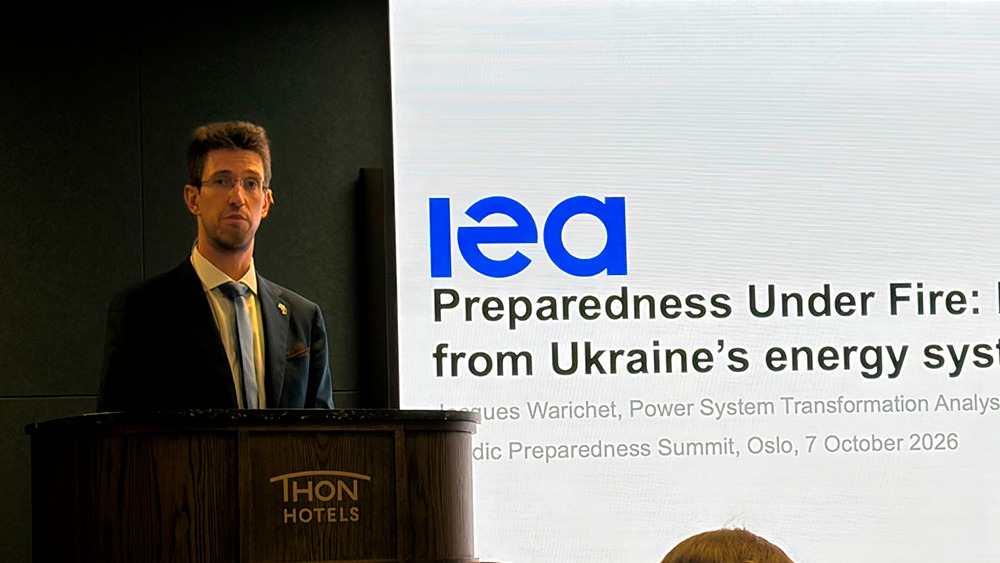
IEA energy analyst Jacques Warichet brought a clear message to ANE’s Nordic Preparedness Summit: resilience must be designed into our systems before a crisis occurs.
Preparedness is not simply about preventing disruption. It is about designing systems, organisations and cooperation so that society can continue functioning and recover quickly when disruption inevitably occurs.
This was one of the central messages from Jacques Warichet, Energy Analyst at the International Energy Agency (IEA), at ANE’s Nordic Preparedness Summit.

Drawing on lessons from Ukraine’s energy system since the large-scale attacks on its energy infrastructure began in 2022, Jacques Warichet showed why resilience requires us to think beyond whether infrastructure can withstand a single failure. We also need to ask what happens when several things go wrong at the same time, how quickly essential systems can be restored, and what arrangements are already in place when national capacity is not enough.
From reliability to resilience
A reliable system is not necessarily a resilient one.
Two energy systems may perform equally well under normal circumstances but behave very differently when something exceptional happens. One might recover within minutes. Another might take days or weeks. And as electricity disappears, the effects spread to heating, water supply, telecommunications and other critical services.
That makes recovery time crucial.
As Jacques Warichet put it, resilience needs to be considered when systems are designed, rather than added after a crisis has begun. That means planning for extreme but plausible scenarios and being explicit about the consequences we are prepared to accept if critical infrastructure fails.
Watch the presentation
Watch Jacques Warichet’s full presentation from ANE’s Nordic Preparedness Summit for practical lessons from Ukraine—and a fresh look at what Nordic engineers need to build into our systems before the next crisis:
https://www.youtube.com/watch?v=zuwBjAlrWO0
Engineering preparedness in the Nordic-Baltic region
These questions are also at the heart of ANE’s work on engineering preparedness.
ANE’s report, Engineering Preparedness for a Contested Nordic-Baltic Region, examines whether the Nordic countries have, and can mobilise, the engineering capacity and competencies needed to keep critical systems operating, adapt them under pressure and restore them following disruption.
Download ANE’s report: Engineering Preparedness for a Contested Nordic-Baltic Region